

DR. SHERRI TENPENNY

Doctor, Speaker, Educator, Consultant

Join Tenpenny Prime for New Medical Content Every Month

DR. SHERRI TENPENNY

Doctor, Speaker, Educator, Consultant

The Sweetest Poison on the Shelf

Your sweet tooth may be killing you

“Sugar, without question, is the number one murderer in the history of humanity—much more lethal than opium or radioactive fallout.” ~~Dr. Nyoiti Sakurazawa


An acquired taste for sweets has evolved over centuries. In ancient times, people would satisfy the desire for sweets with raw honey. However, today we generally seek out something made with refined sugar, called sucrose, to satisfy a “sweet tooth.” And sweeten things we do. In fact, the typical American diet is so laden with sucrose that it should be declared a national disaster.


At the turn of the century, 66% of carbohydrates consumed by Americans came from complex sources. Today, nearly 50% of the carbohydrates that are consumed are made with refined, simple sugars. The average American consumes 17 teaspoons (71.14 grams) every day. That translates into about 57 pounds (about 27 kg) of sugar per person each year! That’s 129 cups per year or 1/3 cup of sugar per day consumed in candy, cookies, breakfast cereals, and Starbucks’ frappuccinos, to name but a very short list of sweet foods. Soft drinks are the primary source of sucrose in the diet. Some sodas contain as much as 12 teaspoons per can. 


It has been said that if you were to drink just one 12-ounce can of a sugar-sweetened soft drink every day and not cut back on calories elsewhere, you would gain at least 5 pounds per year!


If you don’t think that you eat that much sugar, think again. As much as 76% of the refined sugar in foods is “hidden.”  Sugar is the #1 food additive and can show up unaware in salad dressings, soups, peanut butter, canned goods, and catsup.  Refined sugar not only adds pounds to the waistline, it has been implicated in diseases ranging from hyperactivity and hypertension to cancer.


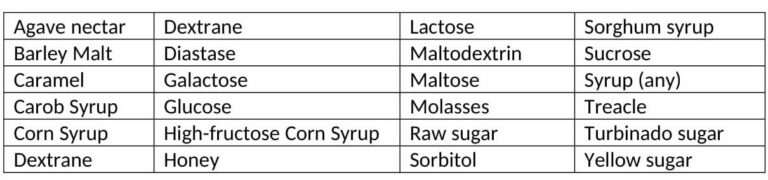
Partial list of hidden names for sugar:
What is that makes sugar so bad for you?


History

 
Cultivating sugarcane as a crop dates back to antiquity. Its origin is thought to be in what is now Papua New Guinea. The plant spread along human migration routes to southeast Asia and India. Around 500 B.C., India developed the technology for removing sucrose from cane juice and then turning it into crystallized sugar granules.


The plant arrived in Southern Europe during the Middle Ages. Men were taken from Lagos, Africa, in the 1640s and sold into slavery to work the sugar cane fields in Seville, Spain. Soon after that, Portugal and the Netherlands also began using slavery to work in their sugarcane fields in Brazil.


By 1660, the British sugar trade had become so profitable that it was considered a matter of national security. The Navigation Act of 1660 was passed, which prevented shipments of sugar, tobacco, or any other product produced in the American colonies from going to any location other than countries and islands that were part of the British Empire. Within two years of its passage, the British were importing 16 million pounds (7.2M kg) of sugar from cane per year.  To expedite processing and decrease wastage through spoiling, the first American sugar refinery was built in New York City in 1689. Demand for sugar worldwide continues to grow each decade and continues to grow even today.

Sugar Cane Becomes Sugar

 
The main sugar found in the sap of all green plants is sucrose. Minor sources of sucrose include maple trees and date palms. Sucrose for the refining process primarily originates from two sources, sugarcane and sugar beets. Both of these are converted into common white table sugar.


Sugarcane is a large, thick stalk of grass that is grown in tropical and subtropical climates worldwide. It is a perennial, meaning it doesn’t have to be replanted every year. New shoots will sprout from cut stalks. Typically, farmers will harvest crops from one planting for about 3 to 5 years, depending on the environment in which it is grown. The stalk comes in various colors, including white, yellow, deep green, purple, red, and violet. Mature canes can grow to be 26 feet tall (8 meters) and more than 2 inches thick (5 cm).  Prior to harvesting, farmers sometimes burn sugarcane to reduce the amount of leafy extraneous material remaining when the cane to the factories for processing.
Approximately 13% of the sugarcane sap is sucrose. It is removed from the fibrous cane by soaking it in hot water and squeezing the pulpy mash through three sets of heavy rollers. The extracted liquid is dark grayish-green in color and very acidic. Lime, sulfur dioxide, and/or phosphoric acid are added to the raw juice, which is then boiled several times to remove impurities. The crystallized sucrose is removed via centrifugation, packaged, and sent to refineries.  There, the process starts all over again. The crystals are washed, dissolved in hot water, and then centrifuged several times to remove the residual pulp and other impurities.
 
One of the final steps involves passing the slurry through bone char to remove impurities to whiten the appearance. The filtered product is crystallized, spun, dried, and packaged — ready for supermarket shelves as the white sugar we are familiar with.


Bone char is made from grinding bones from dead cattle and pigs and then roasting them in a kiln.  The bones, procured from Afghanistan, India, Pakistan, and Argentina, are sold to traders in Scotland, Egypt, and Brazil, who turn them into char and sell it back to the sugar industry. 


The fibrous cane left behind is known as bagasse. It has a range of uses, including turning into fuel to generate energy for the sugar manufacturing process. It is also used as fiber for paper production and can be used for animal feed.


Sugar is Not Food

 
The refining process makes sucrose into only empty calories, completely removing any residual vitamins, minerals, and fiber present in the original sugarcane. Without them, refined sugar in not only a non-nutritional substance, it is actually an “anti-nutrient.” 


In this stripped-down state, the body cannot process this refined substance. Sucrose leaches vitamins and minerals from the body, placing a demand on digestion, detoxification, and elimination. Is it any wonder that Dr. Aseem Malhotra, a UK cardiologist and science director of Action on Sugar, said: “Added sugar has no nutritional value whatsoever and causes no feeling of satiety.”


Major by-products of sucrose production are molasses, soft brown sugar, English coffee sugar, and candy sugar. Molasses is the thick syrup that remains after the sucrose crystals are removed after the precipitation process. Sold as syrup, the molasses is often used to make alcoholic beverages, particularly rum.  Soft brown sugar is white granular sugar that retains some molasses. Large, brown sugar crystals with a caramel flavor are packaged and referred to as English coffee sugar. This sugar is a mixture of partially purified sucrose and a residual of molasses. Sucrose granules that remain very large in size are packaged as candy sugar.


Organic sugar is made from evaporated cane juice. It retains some molasses, which gives it a darker color, and a few antioxidants, minerals, and vitamins B6 and C. Organic sugar is grown without the use of synthetic pesticides or herbicides. However, if packaged food is simply labeled “organic,” it can contain up to 30% genetically engineered food or other contaminants.


Turbinado sugar is a less processed option than white sugar and retains a small amount of molasses. Sugar In The Raw is a brand name for turbinado sugar. It is made by spinning sugarcane through special turbines, creating crystals that are larger than traditional table sugar. Any type of sugar created by sucrose processing has no nutritional value.

Sugar Beets

 
In the late 1700s, sugar beets began to be cultivated for sugar. However, it wasn’t until 1802 that the first beet sugar factory was built in Silesia, a region now located mainly in Poland with small strips in the Czech Republic and Germany.  Over the next 50 years, more than 40 beet processing factories were established throughout France, replacing European dependence on sugarcane. Sugar beet refining began in the U.S. in Alvarado, California in 1872. By the end of the century, there were 30 factories in operation throughout the US.


Sugar beets are primarily used to produce sugar. They aren’t found in the grocery store. The purple, round vegetables we eat known as beets in North America are a different varietal. The British refer to it as the table beet, garden beet, red beet, dinner beet, or golden beet.
Each sugar beet contains approximately 14 teaspoons of sugar. The sugar beets are grown in temperate climates, where sugarcane will not grow. Each harvested acre of sugar beets is the source of nearly 4 tons of refined sugar. After harvesting the beets, they are shipped to factories where the tops are removed and used as cattle feed. They are washed, sliced, and boiled. The pulp is centrifuged to remove the beet juice. Lime is added to the slurry, which is then boiled and placed into settling tanks to crystallize. The refined sugar is packaged and classified for sale according to grain size as extra-coarse, coarse, standard, fine, or extra-fine. The final product cannot be distinguished from sugar processed from sugarcane.


Sugar-Related Illnesses

 
Carbohydrates are composed of three types of simple sugars: glucose, fructose and galactose.  Fructose, found in fruit, is chemically the same as galactose, created by the body.  These individual sugars are called monosaccharides. When they are combined together in groups of two, they are referred to as disaccharides or double sugar.  


Important and readily recognized disaccharides are:
  • sucrose: (glucose + fructose)…….refined table sugar
  • lactose:  (glucose + galactose)……milk sugar
  • maltose: (glucose + glucose)……..grain, sugar
 
Consuming so much refined sugar has been shown convincingly to be associated with many health problems including:
  • Hyperactivity
  • Obesity
  • Hypertension
  • Elevated cholesterol -Yes, elevated cholesterol. Cholesterol is a fat. However, it is manufactured in the body from carbohydrates, NOT fat!  ‘
  • Indigestion/reflux
  • Suppressed immune system
  • Type 2 diabetes
  • Osteoporosis
  • Cancer
 
In future substacks, I will be addressing some of these conditions in detail in future substacks.

WHAT YOU CAN DO

 
REMEMBER: 4 grams of sugar = 1 teaspoon
 
Keep this tip in mind when reading nutrition labels to visualize just how much added sugar the product contains. For example, one 12-ounce can of cola contains almost 12 teaspoons of sugar! This is a really good reference for further learning.


Another really good reference with graphics can be found here.


Completely eliminate all refined carbohydrates from the diet for one week.  Because of the addictive component of refined carbs, you may actually experience symptoms of withdrawal:  mood swings, irritability, depression, and fatigue. However, within just ONE week, many of the health symptoms will begin to subside. Within two weeks, the cravings will be completely gone, and if continued for 3 months, the health benefits will be overwhelmingly positive. 


To help with this process, consider adding Gluco-control to your supplement regimen. If you missed this podcast, it is a MUST to listen to so that you can understand sugar control. If you lock in the BoGo special (buy one, get one free) by the end of the month, you will be able to continue BoGo purchases or the rest of the year! What a deal!!

Share This Post

More To Explore

08-09-21 Deep Dive PREMIUM – with Jamie Walden

Meet Jamie Walden, of Omega Dynamics. Imbued with matchless passion for all things “adventurous” and “fun”, Jamie’s teen years were filled with significant tumult (injuries, arrests, and choices of near life-long consequence). However, amid the rebellion and ruckus, Jamie continually endeavored to one day earn the title, “U.S. Marine”. After being nominated to attend the National Youth Leadership Forum on Defense, Intelligence, and Diplomacy in Washington, D.C., where he subsequently secured a nomination to the US Naval Academy, Jamie made the determination to simply enlist in the Marine Corps Infantry and achieve his childhood dream.

After leaving the Marines Corps, Jamie obtained a double major B.S. in Law Enforcement and History. Pursuing a career in Federal Law Enforcement, Jamie was selected as an Intern for the United States Marshals Service, and subsequent recruitment to a “Three Letter” agency. It was then, when Jamie received “the call”, that the Lord began testing and affirming the genuineness of his faith.

After again returning to Iraq in 2014 to serve the Christians suffering under the savage campaign of ISIS, Jamie and his wife Virginia were compelled to surrender their paradigm and follow the Lord into full-time ministry.

“The Mission of Omega Dynamics is this: to teach, train and equip “Those with ears to hear” to stand anew in their rightful place as more than conquerors in a kingdom that cannot be shaken…this generation is literally, eternally dying for us to”

This post is only available to members.

Deep Dive PREMIUM with Dr Peter McCullough

https://media.blubrry.com/2754542/wordpress-675139-2217541.cloudwaysapps.com/wp-content/uploads/2021/DeepDiveaudiomp3m4a/08-03-21-Dr-Peter-McCullough-Deep-Dive-PREMIUM.m4a Podcast: Play in new window | Download (Duration: 29:45 — 20.2MB) | Embed Subscribe: RSS | More

This post is only available to members.

Deep Dive PREMIUM with Scott Jensen

https://media.blubrry.com/2754542/wordpress-675139-2217541.cloudwaysapps.com/wp-content/uploads/2021/DeepDiveaudiomp3m4a/07-22-21-Dr-Scott-Jensen-Deep-Dive-PREMIUM.m4aPodcast: Play in new window | Download (Duration: 34:11 — 23.2MB) | EmbedSubscribe: RSS | More Dr. Scott Jenson and his wife, Mary, a small animal veterinarian, have raised three very successful children – Cristy, an anesthesiologist, Matt, an estate attorney, and Jackie, a family doctor. He has served many organizations as a board member […]

This post is only available to members.

Do You Want To Book Dr Tenpenny for an Event or Interview?

drop us a line to contact us

Dr Tenpenny Interview