DR. SHERRI TENPENNY

Doctor, Speaker, Educator, Consultant

Join Tenpenny Prime for New Medical Content Every Month

DR. SHERRI TENPENNY

Doctor, Speaker, Educator, Consultant

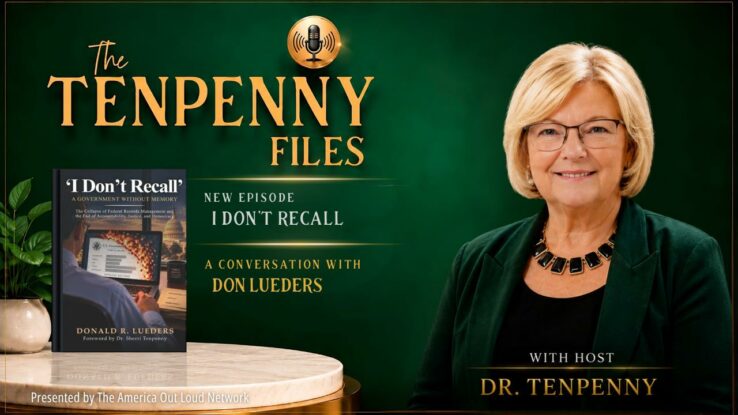
The Tenpenny Files with Don Lueders

10-20-2026
If you prefer to watch the interview, click below:
Washington has spent years investigating some of the biggest controversies in American history. Congressional committees summon witnesses, demand documents, and promise the American people answers. Yet after all the hearings and public testimony, questions remain about what actually happened and who should be held accountable.


Don Lueders believes there is a fundamental problem beneath many of these investigations, one that most Americans have never considered. What if the government cannot reliably establish the authenticity of its own records?


For more than 27 years, Lueders has worked in federal records management, including consulting for the White House, Department of Defense, Department of Justice, and FDA. He knows how government information is supposed to be preserved, and what can happen when those protections fail.


His book, I Don’t Recall: A Government Without Memory, makes a troubling argument about the state of federal electronic records management. I was so impressed by the importance of his work that I agreed to write the foreword.


Consider the investigations surrounding Anthony Fauci and the government’s COVID-19 response. Americans have demanded answers about decisions made behind closed doors and communications between federal officials. Documents have been released through Freedom of Information Act requests, while congressional investigators have questioned witnesses about what they knew and when they knew it.


But Lueders raises a question that changes the way we should examine those records. How can investigators establish what happened if they cannot verify whether the information they received is complete?


The implications reach into other controversies that have dominated the headlines, including Jeffrey Epstein, January 6, and Hillary Clinton’s emails. Lueders believes weaknesses in federal electronic recordkeeping have created serious problems for investigators attempting to establish reliable evidence. His concerns extend across government agencies and political administrations.


And there is another side to this that deserves just as much attention. If official records cannot be trusted, the consequences extend to people who have been accused of wrongdoing. Lueders argues that the same failures that could obstruct an investigation may also prevent someone from establishing their innocence.


What makes his account particularly disturbing is how long he has been raising the alarm.


Beginning in 2013, Lueders took his concerns to government authorities, including inspectors general and the National Archives and Records Administration. He describes years of trying to persuade officials to address a problem he believes threatens the integrity of federal oversight. His experience raises difficult questions about why warnings from someone with decades of relevant professional experience have received so little public attention.


During our conversation, he explains what happened when the federal government moved from paper records to electronic systems. He also challenges the way agencies assess their own compliance with records management requirements, raising concerns about whether those assessments accurately reflect what is happening inside government.


One of the most revealing parts of our discussion concerns the Freedom of Information Act. Americans often assume that when a federal agency responds to a records request, the documents released represent the available evidence. Lueders questions whether the public has any reliable way of knowing what may have been altered or destroyed before that request was made.


Think about the consequences for an investigation that depends on reconstructing conversations between government officials. Even a seemingly complete collection of documents may leave important questions unresolved.


Lueders has spent more than a decade trying to get this issue recognized, and he believes the solution requires fundamental changes in federal records management. He discusses the role of the National Archives and the potential for emerging technology to help preserve trustworthy government records.


His proposed reforms raise another question: If the systems responsible for preserving government information have been inadequate for years, what would it take to restore confidence in the records already being used?


I have interviewed many authors who have challenged the way our institutions operate, but Lueders approaches government accountability from an angle that rarely receives serious public discussion. His professional experience gives him a perspective worth examining, particularly when so many Americans are questioning whether congressional investigations can produce meaningful answers.


The book goes further into the professional history and evidence behind his warnings. Our conversation brings those concerns into the context of investigations Americans are watching today.


Listen to my conversation with Don Lueders and read I Don’t Recall: A Government Without Memory. The next time a government official says they cannot recall what happened, you may find yourself wondering whether the government preserved the records that could settle the question.
 
Meet our Guest
Don Lueders – Federal Records Management Expert, Author and Whistleblower.


Don Lueders has spent more than 27 years working in federal records management, including consulting for the White House, Department of Defense, Department of Justice, and FDA.


As president and founder of Harbor Point Information Management, he has firsthand professional experience with the systems responsible for preserving government records. That experience led him to identify what he describes as serious weaknesses in federal electronic recordkeeping.


Since 2013, Lueders has been raising concerns with federal authorities, including inspectors general and the National Archives and Records Administration. His warnings center on a problem that receives remarkably little public attention: whether government records can be reliably preserved and authenticated when they are needed as evidence.


His book, I Don’t Recall: A Government Without Memory, examines the consequences of those failures for congressional investigations and government accountability.


Dr. Sherri Tenpenny wrote the foreword to his book, recognizing the importance of bringing this overlooked issue before the American public.


Lueders’ work raises fundamental questions about the integrity of official evidence and the ability of government institutions to account for their decisions.


Websites
DrTHawk.com
Book: bookstore.drtenpenny.com


TODAY’S SPONSORS:

Get your 1st bottle of the #1 CELLULAR DETOX on the market for just $14
Daily detox is non-negotiable. With toxins everywhere—in the air, food, and water—you need something effective every day.
 
That’s why I always recommend Pure Body Extra – Zeolite. It’s a cellular level detox, flushing out heavy metals, pollutants, and even mold, safely. 
BUY TODAY at DrTdetox.com


10% OFF Supplements and Apparel with promo code DRT10:

www.shoptenpenny.net

Zero Accountability in a Failed System: How Big Pharma Weaponizes Vaccines, Public Health, and the Law


Dr.Tenpenny’s most definitive work to date, providing a sweeping exposé of the corruption entrenched in the medical establishment, pharmaceutical industry, and government.
 
It highlights how these powerful entities have manipulated public trust, prioritized profit over people, and ignored accountability for the harm they’ve caused.


This book empowers readers with knowledge, uncovers long-hidden truths, and provides actionable insights to navigate and challenge a system designed to suppress dissent and maintain control.


Share This Post

More To Explore

08-09-21 Deep Dive PREMIUM – with Jamie Walden

Meet Jamie Walden, of Omega Dynamics. Imbued with matchless passion for all things “adventurous” and “fun”, Jamie’s teen years were filled with significant tumult (injuries, arrests, and choices of near life-long consequence). However, amid the rebellion and ruckus, Jamie continually endeavored to one day earn the title, “U.S. Marine”. After being nominated to attend the National Youth Leadership Forum on Defense, Intelligence, and Diplomacy in Washington, D.C., where he subsequently secured a nomination to the US Naval Academy, Jamie made the determination to simply enlist in the Marine Corps Infantry and achieve his childhood dream.

After leaving the Marines Corps, Jamie obtained a double major B.S. in Law Enforcement and History. Pursuing a career in Federal Law Enforcement, Jamie was selected as an Intern for the United States Marshals Service, and subsequent recruitment to a “Three Letter” agency. It was then, when Jamie received “the call”, that the Lord began testing and affirming the genuineness of his faith.

After again returning to Iraq in 2014 to serve the Christians suffering under the savage campaign of ISIS, Jamie and his wife Virginia were compelled to surrender their paradigm and follow the Lord into full-time ministry.

“The Mission of Omega Dynamics is this: to teach, train and equip “Those with ears to hear” to stand anew in their rightful place as more than conquerors in a kingdom that cannot be shaken…this generation is literally, eternally dying for us to”
This post is only available to members.

Deep Dive PREMIUM with Dr Peter McCullough

https://media.blubrry.com/2754542/wordpress-675139-2217541.cloudwaysapps.com/wp-content/uploads/2021/DeepDiveaudiomp3m4a/08-03-21-Dr-Peter-McCullough-Deep-Dive-PREMIUM.m4a Podcast: Play in new window | Download (Duration: 29:45 — 20.2MB) | Embed Subscribe: RSS | More

This post is only available to members.

Deep Dive PREMIUM with Scott Jensen

https://media.blubrry.com/2754542/wordpress-675139-2217541.cloudwaysapps.com/wp-content/uploads/2021/DeepDiveaudiomp3m4a/07-22-21-Dr-Scott-Jensen-Deep-Dive-PREMIUM.m4aPodcast: Play in new window | Download (Duration: 34:11 — 23.2MB) | EmbedSubscribe: RSS | More Dr. Scott Jenson and his wife, Mary, a small animal veterinarian, have raised three very successful children – Cristy, an anesthesiologist, Matt, an estate attorney, and Jackie, a family doctor. He has served many organizations as a board member […]

This post is only available to members.

Do You Want To Book Dr Tenpenny for an Event or Interview?

drop us a line to contact us

Dr Tenpenny Interview